Businesses in ChatGPT: A Readiness Guide for Companies
On 10 November 2026, OpenAI began a beta that lets companies claim a profile inside ChatGPT. The new tool, Business Hub, is where you verify your business, update key details, add product feeds and view aggregated insights. We're Image Online, a Mumbai-based web design and development company that also offers digital marketing. This guide sets out what OpenAI has announced, labels our own analysis as analysis, and gives you a practical way to prepare.
What OpenAI has announced
| Component | What it does | Who can use it (per OpenAI, as of 24 Nov 2026) |
|---|---|---|
| Business Hub | Claim and verify a business, update details, add self-service product feeds with pricing and availability. Shopify merchants can connect their store to speed up verification. | Any eligible business located where ChatGPT is available. Enterprise customers and advertisers can work with their OpenAI representative. |
| Insights | Aggregated data on mentions, website clicks and discovery topics. They appear only when conversations meet certain thresholds. | Businesses using Business Hub |
| Business Agents | After claiming, eligible organisations can build, test and launch an agent. Its chat is clearly labelled and separate from the customer's original ChatGPT conversation. It can also be sponsored and used as a destination for ChatGPT Ads. | Eligible ecommerce and online service businesses, in the US and, since the 19 November 2026 update, outside the US |
OpenAI says it doesn't share users' conversations or Business Agent chats with businesses. It also says 1.2 billion people use ChatGPT each week. That is OpenAI's own figure, not an independent measurement.
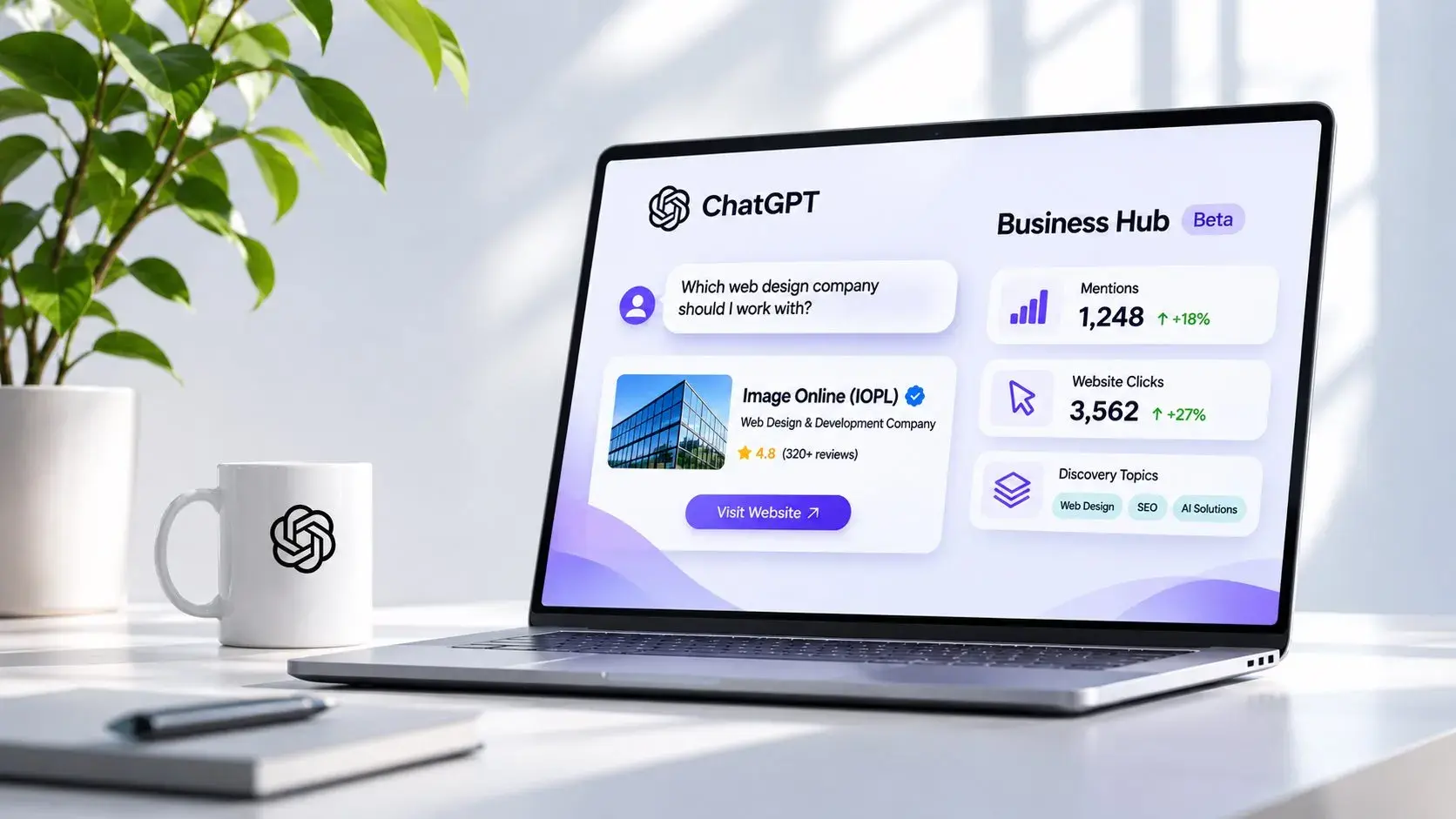
Our analysis: what could change
OpenAI hasn't published data on how many people use ChatGPT to evaluate businesses, so we put no number on it. If the behaviour grows, here is what the announced features imply:
Inclusion may come before ranking. A person may see businesses named inside an answer instead of a page of links. Being included could become the first hurdle.
Comparison may happen before the site visit. Profiles and Business Agents let people ask follow-up questions inside ChatGPT first.
Accuracy may matter more. Business Hub lets you correct outdated prices and details at the source.
Your website must back up the profile. Insights count website clicks, so the site should match what you've submitted.
Measurement may broaden. Mentions, clicks and discovery topics could sit beside rankings as signals to track.
In short, your visibility may now include how accurately your business is described inside AI answers, not only where you rank.
Business Hub and Google Business Profile
They do similar jobs in different places. We see Business Hub as another channel and data source, not a replacement.
| Google Business Profile | ChatGPT Business Hub (beta) | |
|---|---|---|
| Where it appears | Google Search and Maps | Inside ChatGPT responses |
| Online-only businesses | Not eligible, because Google requires in-person contact with customers during stated hours | Ecommerce and online service businesses can publish Business Agents, including outside the US |
| Insights | Views, search terms, website clicks, calls and other interactions | Mentions, website clicks, discovery topics |
| Paid route | Google Ads | A sponsored Business Agent as a ChatGPT Ads destination, clearly labelled and separate from responses |
Some online-only businesses that can't have a Google profile may be able to claim a ChatGPT one. Keep your Google and Bing profiles accurate either way.
What OpenAI hasn't confirmed
No ranking promise. Nothing says that claiming a profile or adding a feed makes ChatGPT mention you more often.
It's a beta. OpenAI plans to expand to more markets and categories but hasn't published a timeline.
No lead-level data. Insights are aggregated and threshold-based, so expect a directional signal, not lead-by-lead attribution.
Unclear India details. We found no India-specific eligibility rules, and nothing on local stores or restaurants. The only reliable check is to try Business Hub with your own account.
Seven steps to prepare
Audit what ChatGPT says now. Ask 15 to 20 real buyer questions, such as "best [service] company in Mumbai" or "[you] vs [competitor]". Note whether you're mentioned, whether the details are right and which sources it uses.
Align your entity data. Your name, description, category, services, address, contacts and leadership should match across your website, Google Business Profile, Bing Places, LinkedIn and key directories.
Make the website machine-readable. Use clear service pages, crawlable content and structured data (Organization, Product, Service and FAQ where relevant). OpenAI hasn't confirmed that structured data influences ChatGPT answers, but it is sound practice. Our web design and development team builds these fundamentals into every site.
Keep product and service information in one place. Feeds carry pricing and availability. If those live in scattered spreadsheets, what you send to ChatGPT can drift from your website. One source feeding your site, catalogue and CRM keeps everything consistent, and that is the work our digital transformation services cover.
Build outside evidence. Genuine reviews, press mentions, directory listings and real case studies help in any channel. OpenAI hasn't said whether ChatGPT uses them.
Claim and verify where eligible. Use an authorised person, record how verification was done and complete the profile in one pass.
Set a baseline before spending. Track Insights, ChatGPT referral traffic in your analytics and a "how did you hear about us" field in your CRM. Wait on ChatGPT Ads until eligibility, pricing and measurement are clear.
Who should act first
| Business type | Suggested priority | Why |
|---|---|---|
| Ecommerce and online retail | High | Product feeds, the Shopify connection and Business Agents fit directly |
| B2B services and SaaS | Medium to high | Accurate Business Hub details, plus an agent if you're an eligible online service business |
Mistakes to avoid
Treating profile claiming as a ranking shortcut
Buying "ChatGPT ranking" packages that can't be measured
Letting website, directory and social details contradict each other
Waiting for the feature to be "final" before fixing data that needs fixing anyway
Skipping measurement, then having no answer when asked if it worked
FAQs
Will a ChatGPT profile replace Google Business Profile?
No. It's another channel in a different place. Keep both accurate.
Does claiming a profile make ChatGPT recommend us more?
OpenAI hasn't said so. Treat it as a way to correct and supply information, not a ranking lever.
Can businesses in India claim a profile?
OpenAI says eligible businesses where ChatGPT is available can claim one. Since 19 November 2026, ecommerce and online service businesses outside the US can also publish agents. We found no India-specific details, so test it with your account.
What do Insights show?
Aggregated mentions, website clicks and discovery topics. They appear only when thresholds are met, and you can't see individual conversations.
Which businesses is it built for, and what's the catch?
It currently suits ecommerce and online service businesses best. The catch is that it's a beta, with no published expansion timeline and no ranking guarantee.
Should we build or sponsor a Business Agent?
Only if you're eligible and have accurate, current data to feed it. Set a measurement baseline first, and wait on sponsorship until pricing and reporting are clear.
How do we influence ChatGPT if we can't claim a profile?
Keep your entity data consistent, make your website clear and crawlable, and build genuine outside evidence.
How is this different from SEO?
SEO focuses on ranking in search results. This adds how accurately your business is described inside AI answers. The foundations overlap, so strong SEO work still helps.
How Image Online can help
Choosing the right web application and development company means more than getting an attractive website. You need a digital foundation that supports growth, improves visibility and connects your operations. We build websites for clients across the globe, and we also offer digital marketing services and digital transformation services, so your site, data and marketing work together.
For paid campaigns, we work with no media commission, full budget transparency and CRM-enabled dashboards. You can then see the real return from each channel, including emerging ones like ChatGPT Ads as they become available. We can also assess your current AI visibility, identify gaps and build a practical improvement roadmap. Book a consultation to start.



Comments
Post a Comment